You Don't Have Your Own AI (And Why That's Actually Brilliant)

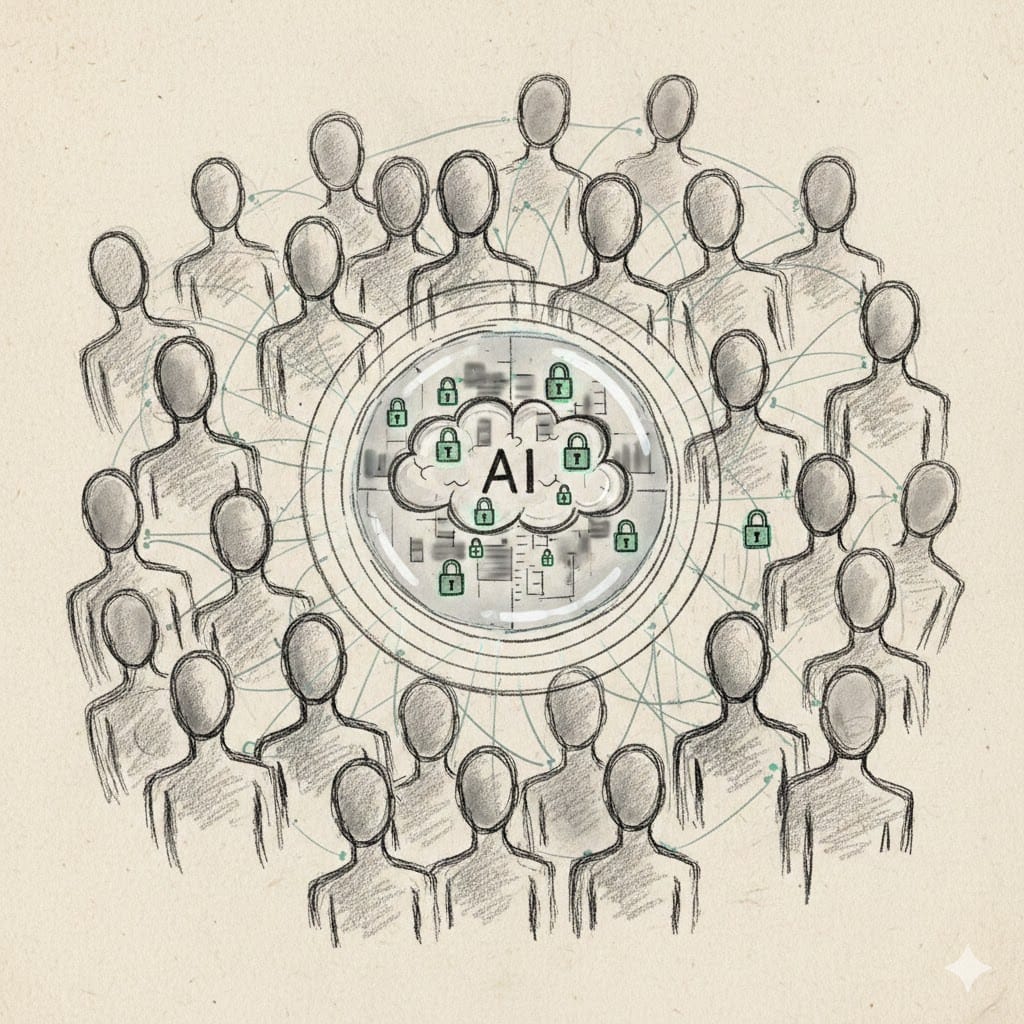
While exploring the concept of LLM OS, I started thinking about how sessions and users work—similar to traditional operating systems. This led me to wonder: what actually happens when multiple people access the same LLM simultaneously?
When you fire up ChatGPT or Claude and start typing, it feels personal. Like you've got your own AI sitting there, waiting just for you. However, you're sharing that LLM with potentially millions of other people at the exact same moment.
And yet, your conversation stays completely private. Your context doesn't leak into someone else's chat. Nobody sees what you're asking about, and the AI doesn't suddenly start talking to you about someone else's weekend plans.
How does that actually work?
The Shared Computer Model
It turns out the architecture mirrors familiar OS patterns more than you'd think. The LLM functions as a shared computational resource processing requests from all users, much like a multi-user operating system from the 1970s—think Unix terminals, where dozens of people used the same mainframe simultaneously.
The model itself—those billions of parameters that cost millions to train—is shared infrastructure. When you send a prompt, you're not spinning up your own copy of GPT-4 or Claude. That would be absurdly expensive and technically impractical. Instead, you're getting a time slice of the same model everyone else is using.
But here's where it gets interesting.
Your conversations? Those are stored separately in databases tied to your account. Each time you send a message, the system retrieves your conversation history, processes it through the shared model, generates a response, and persists the updated state back to storage.
Think of it like this: the model is the CPU, and your conversation history is your program state. The CPU doesn't remember what it computed yesterday. It just processes whatever you feed it right now.
Stateless by Design
What's fascinating—and crucial for understanding how this all works—is that the model itself is completely stateless. It has no inherent memory of you or any user. Between requests, it's essentially a blank slate.
When you reference something from earlier in your conversation—"like I mentioned before" or "going back to what we discussed about Python"—the model isn't actually remembering that. The system is loading your entire conversation history from storage and feeding it back through the model along with your new message.
Every single time.
This is why context windows matter so much. Claude's 200K token context window or GPT-4's 128K window—these aren't just marketing numbers. They're the literal limit of how much conversation history can be included in a single request.
All conversational context comes from external storage, not from the model's parameters. This design choice is actually what ensures privacy: you're never sharing context with other users because the context never lives in the shared model. It's always pulled fresh from your isolated storage.
The Request Lifecycle
Let's walk through what actually happens when you hit send on a message:
1. Authentication and Session Identification
Your request arrives at the API gateway with authentication tokens and a session identifier. This is what tells the system "this is user XYZ, conversation ABC."
2. Context Retrieval
The system queries a database—probably something like PostgreSQL for durable storage or Redis for active sessions—and pulls your complete conversation history. This includes all previous messages, system instructions, and any metadata about the conversation.
3. Prompt Construction
Your new message gets appended to this history, creating the complete prompt that will be sent to the model. For a 50-message conversation, you might be sending 20,000+ tokens to the model just for context.
4. Model Inference
The shared model processes this complete context and generates a response. This is the expensive part—both computationally and financially. The model performs billions of calculations to predict the next tokens in the sequence.
5. Response Streaming and Storage
The response gets streamed back to you (that's why you see it appear word by word), and simultaneously, the system saves the updated conversation state back to the database. Your new message and the AI's response are now part of your permanent conversation history.
6. State Persistence
The database transaction commits, ensuring your conversation is durably stored. If you close the browser and come back tomorrow, that same history will be loaded again.
The entire cycle happens in seconds, and the model itself never "knows" anything beyond that single request-response cycle.
Isolation Mechanisms
So how does the system guarantee that my conversation doesn't somehow bleed into yours?
The isolation works at multiple layers, like security defense in depth:
Architectural Separation
At the infrastructure level, every request includes authentication tokens that are validated before anything else happens. You can only access conversation histories associated with your account. There's no API endpoint where you could even theoretically request someone else's chat—the authorization layer prevents it at the entry point.
Session-Based State Management
Each conversation gets a unique session ID, typically a UUID or similar identifier. When the system loads context, it's doing something like:
SELECT messages FROM conversations WHERE user_id = 'your_user_id' AND session_id = 'this_conversation_id' ORDER BY timestamp
There's no way for data from another user's session to accidentally get included because the database query is scoped to your specific identifiers.
Model-Level Isolation
The model itself provides zero cross-contamination risk because it's completely stateless. It doesn't learn from your conversation in real-time. Your prompts don't update the model weights. The parameters remain frozen during inference.
When the model processes my request at 10:00 AM and your request at 10:01 AM, it has no memory of processing mine. Each request is independent.
Encryption Everywhere
Your conversation data is encrypted at rest in the database and in transit over the network. Even if someone somehow intercepted the traffic or accessed the raw database, they'd need decryption keys to make sense of it.
Rate Limiting and Abuse Prevention
The infrastructure includes rate limiting to prevent one user from monopolizing resources or attempting to extract information about other users through timing attacks or resource exhaustion.
Can Cross-Contamination Happen?
The short answer: no, not in normal operation.
Cross-user contamination is architecturally impossible with this design. Different sessions map to different stored histories, all leveraging the same underlying model. Your context window never intersects with mine. We're not sharing state; we're sharing computation.
But let's dig into the nuances and edge cases, because understanding the limits is just as important as understanding the capabilities.
The Fine-Tuning Question
One area where user data could theoretically influence the model is through fine-tuning or continual learning. Some providers do periodically update their models using anonymized, aggregated data from conversations.
However, this happens offline, in batch processes, with strict privacy controls. Your specific conversation isn't being used to update the live production model in real-time. There's a clear separation between:
- The inference system (what you interact with daily)
- The training pipeline (periodic model updates using sanitized data)
Enterprise customers often get explicit guarantees that their data won't be used for model training at all. OpenAI's API, for example, doesn't use customer data for training unless explicitly opted in.
Infrastructure Spillover
While your conversation content can't leak into mine, there are indirect effects of sharing infrastructure:
Heavy load from one user or a surge in traffic can slow response times for everyone. If someone is running thousands of requests per second, they might exhaust connection pools or cause queuing delays that affect other users.
Resource contention is real in shared systems, but it manifests as performance degradation, not data leakage.
Prompt Injection Considerations
There's been a lot of discussion about prompt injection attacks—where malicious instructions in user input could theoretically manipulate the model's behavior. But these attacks target the model's instruction-following capabilities, not cross-user data access.
If I trick the model through a clever prompt, I might get it to behave unexpectedly in my conversation. But I can't use prompt injection to access your conversation because your context literally isn't present in my request. The isolation happens before the prompt ever reaches the model.
Providers implement safeguards against this anyway—input filtering, output validation, and safety classifiers that detect and block malicious patterns.
The Economics of Sharing
This architecture isn't just about technical feasibility—it's about economics. Shared infrastructure is what makes LLMs viable as a service.
Training a frontier model costs tens to hundreds of millions of dollars. The GPUs alone run into eight-figure monthly bills. If every user needed their own model instance, the cost would be astronomical.
By sharing the expensive part (the model weights and inference compute) while isolating the cheap part (text storage in databases), providers can offer these services at a price point that works for both businesses and individuals.
Your conversation history might be a few megabytes of text. The model itself is hundreds of gigabytes. The cost differential is orders of magnitude.
This is why context windows are the battleground for differentiation. Increasing context length doesn't require new model weights—it's "just" an engineering challenge of handling longer prompts efficiently. But it dramatically improves the user experience by allowing more conversation history to be included.
What This Means for Privacy
Understanding this architecture should actually make you feel better about privacy, not worse.
Your conversations aren't floating around in some shared memory space where they might leak. They're in a database, encrypted, tied to your account, and only accessed when you specifically request them through authenticated API calls.
The model processes your data transiently—it never persists in the model itself. Once your response is generated, the model has no record of your conversation. It's already processing the next request from someone else.
That said, you should still be thoughtful about what you share with AI systems:
- Conversations are stored on company servers, subject to their privacy policies
- Employees might review flagged conversations for safety purposes
- Court orders or legal processes could compel disclosure
- Data breaches, while unlikely, are never impossible
But the multi-user architecture itself isn't a privacy weakness—it's actually a strength. Isolation through statelessness is more secure than trying to manage isolation in a stateful system.
The Future: LLM OS
This architecture is why people like Andrej Karpathy talk about LLMs as the kernel of a new kind of operating system—the LLM OS.
Traditional operating systems manage hardware resources—CPU, memory, storage—and provide isolation between processes. They handle scheduling, security, and resource allocation.
LLM systems are doing something analogous:
- Managing computational resources (GPUs, model weights)
- Providing isolation between users (session management, authentication)
- Handling scheduling (request queuing, batching)
- Offering APIs for applications to build on top
The conversation history is your process state. The model is the kernel. Tools and integrations are syscalls.
We're seeing this evolve with features like:
- Persistent memory across conversations
- Function calling and tool use
- Multi-agent systems that orchestrate multiple LLM calls
- Integration with external data sources and APIs
The analogy isn't perfect, but it's useful. It helps us think about how to build on these systems, what the security boundaries are, and where the architectural challenges lie.
Wrapping Up
When you chat with an LLM, you're participating in an elegant dance of shared computation and isolated state.
The model itself—billions of parameters representing compressed knowledge—serves everyone simultaneously. But your conversation, your context, and your data remain yours alone, protected by layers of architectural and security controls.
It's an elegant solution: share the computationally expensive inference infrastructure while isolating the relatively lightweight conversation state. That's what makes LLMs viable at scale.
Next time you send a message to ChatGPT or Claude, you'll know: you're not talking to your own private AI, but you are having a genuinely private conversation. The distinction matters.
📩 Please feel free to share this article with colleagues and friends who will find it valuable.
Thanks for reading!
Have a great day!
Bogdan
Further Reading:
- OpenAI API Documentation - Technical details on conversation state management
- Anthropic's Model Context Protocol - Framework for connecting LLMs to data sources
- OWASP Top 10 for LLMs - Security considerations including prompt injection